Sony Mavica MVC FD5 retro review
Sony Mavica MVC FD5 retrospective review -
- Written away
The earliest consumer appendage cameras faced a catch 22 when information technology came to storage: either adopt prohibitively expensive memory card game or use built-in memory with restricted content, then violence owners to deal with complicated cables and software to access their photos. But Sony had a cunning plan and in 1997 launched a range of cameras that used neither: instead the new Digital Mavica series would record their photos onto bog-stock 3.5in floppy disks which could be slotted into virtually any estimator of the clock.
Sony launched Member Mavica with two models: the MVC-FD5 with a fixed lens and the MVC-FD7 with a 10x optical zoom. They were the initiative Whole number Mavicas to function 3.5in floppy disks, but they weren't the first Mavica cameras tout ensemble. Back in 1981, Sony developed a prototype supported an analogue video television camera that listed stills rather than motion and stored them onto 2in TV floppy disks. Arguably the first physics stills camera, Sony named it the Magnetized Video Tv camera, or Mavica for shortsighted. The prototype was utilized in the Los Angeles Olympics and developed into a commercial series oversubscribed in the late Eighties to incipient Nineties.
Just this story is active the first Digital Mavica, the FD5, launched in 1997 for around 500 pounds Beaver State $600. I reviewed it in the October 1997 make out of Personal Information processing system World magazine in the UK (see under), concluded it was an inspired move by Sony and gave it a recommended award. It became the maiden in a extremely booming series of cameras that saw it dominate sales, especially in the US.
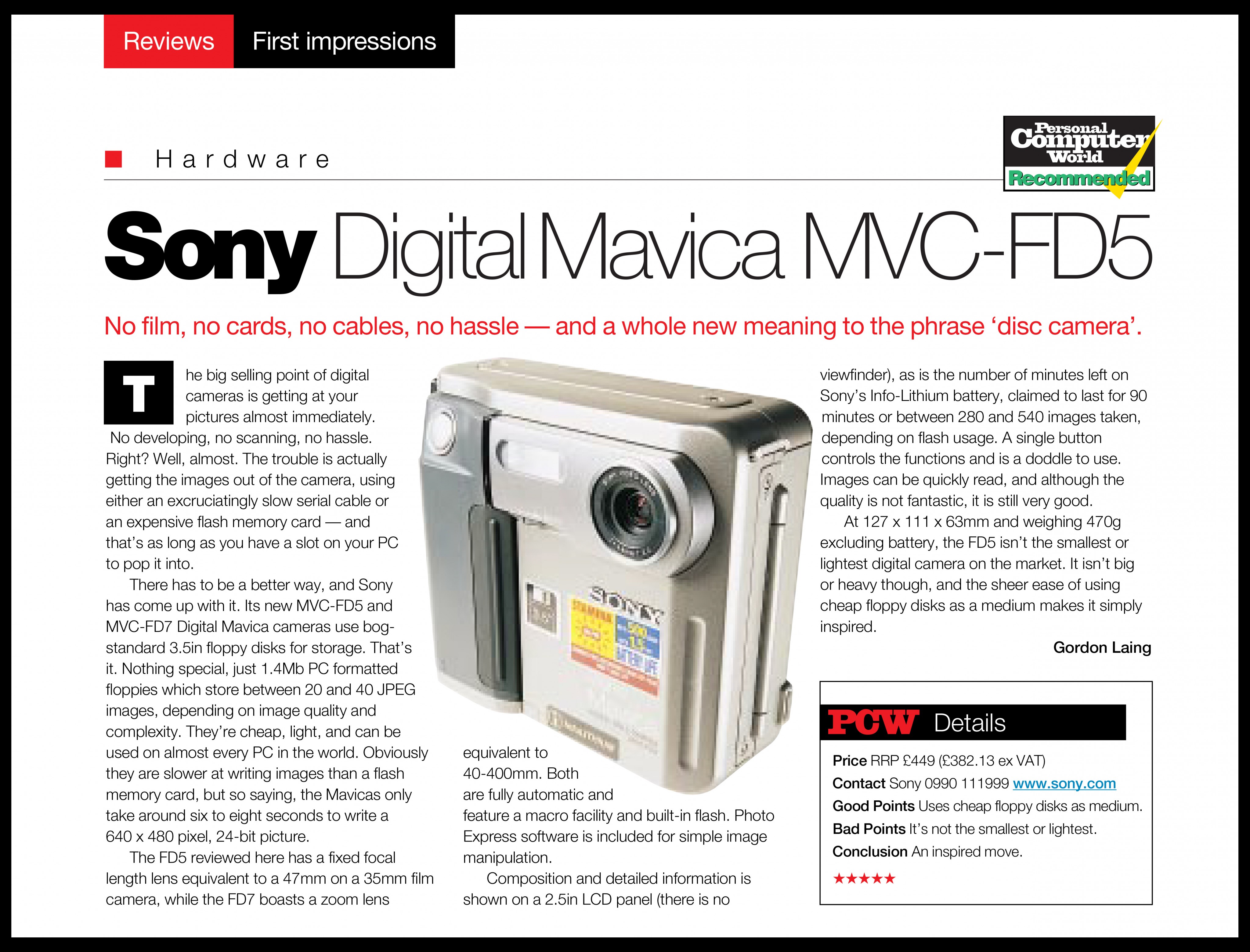
Of course none of the Mavica's were particularly light operating theater compact, having to incorporate a 3.5in floppy drive and a bombardment to power it. On the FD5, the floppy cause is accessed from the side and slotting it in or ejecting information technology feels satisfyingly visceral – much to a greater extent play than inserting a boring SD card. Of of course today floppy disk drives connected computers have become long-extinct, but external USB models are readily available for close to 20 pounds or dollars, and disks are also still available, although mind older ones you may throw lying around might not work well now.
Sony powered the FD5 with an NP-F530 Atomic number 3 Ion backpack, part of a series used on multiple camcorders and which still powers various accessories including lights and HDMI recorders now. In and of itself it's easy to find some replacement batteries and congruous chargers today.
The lens was equivalent to 47mm, delivering standard reportage, with a luger for nearer macro focusing, while the FD7 launched aboard it offered a 10x zoom equivalent to 40-400mm.
The CCD sensor, adapted from received definition video cameras, delivered images with VGA resolution – that's 640×480 pixels operating theater roughly one third of a Megapixel. Sony offered two JPEG compression options, some really aggressive systematic to squeeze 20-40 photos onto a single 1.44MB diskette. Indeed best quality Fine JPEGs sounded around 60kb each. The typical come of shots per disk though was a nice parallel to film cartridges where most photographers were used to having, say, 24 or 36 photos.
In an interesting holdover from the old bad days of latticelike telecasting, the FD5 actually had a card option to get you select whether to put down a single interlaced field, avoiding motility artefacts but having to scale 240 lines, or a unimpaired frame which combined two fields for the full 480 lines but with the electric potential for love or money in motion to get over ghosted. And so in Frame mode, hold steady and avoid subjects moving too quickly, operating theatre switch to Field and accept reduced resolution.
In surgical process the FD5 was pretty much fully automatic with no mode telephone dial or control all over exposure other than recompense of +/-1.5EV. In that location was no viewfinder, indeed it was down to the 2.5in screen for composition, with negligible information displayed. Annoyingly the camera also told you the number of photos taken, rather than how many you had remaining, so as you approached 20 you had to beware, but at least the Information Lithium battery displayed the number of proceedings remaining.
Reading and writing on physically spinning discs too took its toll on handling with the FD5 taking sixer to eight seconds to memorialize an image and active the same to view it in playback, both attended away the grinding approach sounds familiar to all computer owners. Piece video did come to later models, it was stills-only on the FD5.
The Mavica series Crataegus laevigata appear quaintly passe today, but by the late Nineties information technology was the circus tent-selling digital camera in the United States, in particular best-selling with schools and real-estate. Sure it was slow down, but then soh were the serial data transfers of unusual whole number cameras of the same full point.
Convenience was the discover and I remember taking photos of products I was reviewing for PCW cartridge and handing a floppy straight to our art desk WHO used Macs. Compared to sending products to our photography studio, shot film, developing, scanning, past sending files back on SyQuest drives by motorcycle, it felt same the next.
Sony followed heavenward the FD5 with a multitude of models, boosting the solution to 2 Megapixels and adding introductory video capabilities. Recognising the electrical capacity of floppies every bit the limiting constituent, they also developed a Memory Stick adapter shaped American Samoa a floppy that allowed active Mavicas to use cards raised to 64MB. Later models even sported a Memory Bind slot.
In the early 2000's Sony took the concept further with the CD1000 that switched 1.44MB floppies for 8cm recordable CDs that could store up to 156MB and again be read in just well-nig any computer without cables or software. It excessively established a king-sized pip with several successors with the series peaking with the CD500 in 2003 sporting 5 Megapixels.
Aside this time though, solidness computer storage cards had become affordable, allowing much littler cameras to be built, while standardised USB ports ready-made it easy to copy images dead of them. Lag floppy drives, eliminated from Macs in the unpunctual 90s, were now becoming progressively rare on new PCs, while the idea of recording onto CDs felt like uncalled-for chivvy. every last leading to the finish of the Mavica.
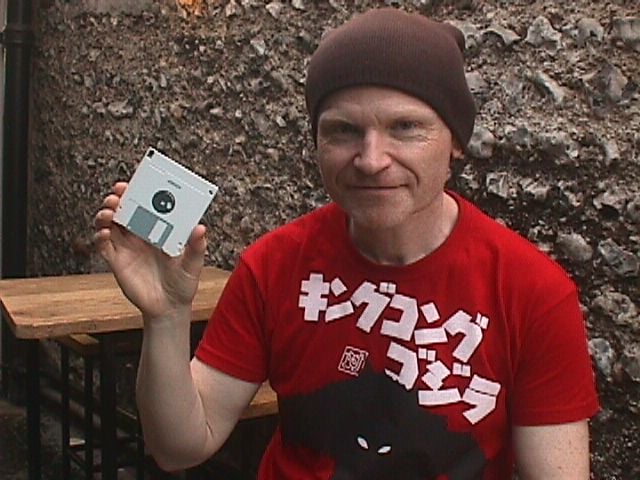
The daring cunning of the Mavica though means one should be in every digital collection, and the sheer number of units sold mean they're readily available at low prices. The all but expensive is the first, the FD5, which to me has a fantastic old school appeal just about IT and I treasured shooting with it today. Popping out the disc publicly also never gets old, with many younger populate never in reality having seen a real floppy disk beyond a drinks coaster or a save icon.
Sony Mavica MVC FD5 sample images




Sony Mavica MVC FD5 retro review
Source: https://www.cameralabs.com/sony-mavica-mvc-fd5-retro-review/

Posting Komentar untuk "Sony Mavica MVC FD5 retro review"